


Solitaire Castle Royal: Cards
Brightpoint Studios Inc
I spent time with Solitaire Castle Royal: Cards as a quiet, pick-up-and-play card game, and its appeal became clear quickly: it turns familiar TriPeaks solitaire into a small royal-building routine. The basic card play stays easy to understand, while the castle theme gives each short session a little more purpose than simply clearing a layout. It is a game for relaxed attention rather than competition, speed, or deep strategy.
That distinction matters. If you want a demanding card battler, a large collection of rule variations, or a social game built around opponents, this is probably not the right download. If you enjoy solitaire, prefer a calm pace, and like having a light progression layer around your card rounds, the combination is much more appealing. I found it especially suitable for short breaks, travel, and those moments when I wanted something interactive without having to learn a complicated system.
How the game turns TriPeaks into a relaxing routine
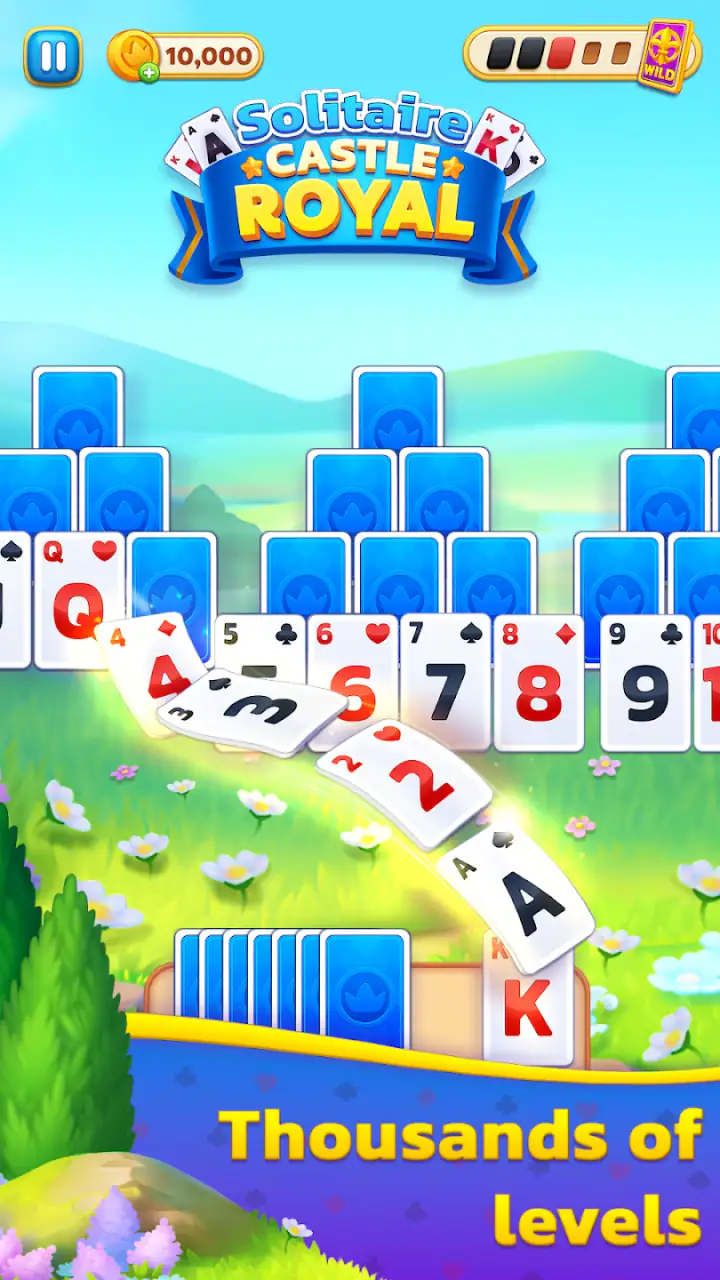
At its core, this is a TriPeaks solitaire game. You work through the familiar arrangement of cards by making sensible sequential moves, clearing what you can and looking ahead for opportunities to open more of the layout. The rules are approachable enough for someone who already knows solitaire, but the changing card arrangement still gives each round a small decision to make.
The royal kingdom theme adds context to that loop. Instead of treating every hand as an isolated puzzle, the game presents progress as part of a broader castle-building experience. That framing is simple, but it helps the sessions feel connected. I was more inclined to play another round when the card clearing felt like a step toward improving the kingdom rather than an endless repetition of identical tables.
The important word is “relaxing.” The game does not need to be played with intense concentration every second. I could settle into a rhythm, scan the available cards, choose a move, and keep going without feeling pressured by a complicated interface. That makes it a good companion for a coffee break or a few minutes before bed, provided you are comfortable with a game whose main reward is steady, low-stress progress.
Related News






What a typical session feels like
A useful way to approach a round is to avoid immediately taking the first available move. I found it better to look at the exposed cards and consider which choice might reveal the most useful follow-up. In TriPeaks, a move that seems attractive now can remove the only card that would have extended a longer chain, so a little patience improves the experience even when the game remains casual.
That creates one of the game’s less obvious strengths: it supports two styles of play. I could play quickly when I only wanted a distraction, or slow down and treat the layout as a compact planning exercise. The same round can therefore serve different moods. The trade-off is that players seeking a highly competitive score chase may find the kingdom presentation more important than precision leaderboard play.
For everyday use, I would keep sessions deliberately short. A few rounds work well when waiting for an appointment or taking a break from work. Because the game is built around recognizable solitaire actions, I did not need a long warm-up after putting it down. That low re-entry cost is more valuable than it sounds; many mobile games punish interruptions, while this one fits naturally around them.
Gallery
Offline play changes where it fits
One of the most practical parts of the experience is the ability to play offline. That makes it useful in places where a connection is unreliable or where I simply want to avoid opening a game that depends on constant online access. A flight, a train journey, a waiting room, or a weak-signal area are all reasonable situations for this kind of card game.
Offline play also changes how I think about the game’s value. It is not only a home-screen time filler; it can become a dependable fallback for travel. I would still install it before leaving rather than assume every part of the experience will behave identically without a connection, but the offline focus is a meaningful advantage over solitaire games that are designed around continuous online events or social systems.
There is a useful trade-off here. Offline solitaire is convenient because it removes dependence on other players, but it also means the experience is self-contained. If you need fresh human competition, live challenges, or a changing multiplayer environment, this format will feel limited. Its strength is independence, not social variety.
Progression gives the cards a reason to continue
The kingdom-building layer is what separates this from opening a plain solitaire app for a random hand. It gives the card rounds a sense of direction and makes successful play feel connected to something visual and ongoing. I liked having that extra reason to continue, especially during longer relaxed sessions when the basic card loop might otherwise start to feel repetitive.
At the same time, the progression should be viewed as a supporting layer rather than a full management game. I would not choose this title expecting a detailed kingdom simulator with complex construction decisions, resource planning, or a large strategic map. The card game remains the center of attention. The castle theme improves the presentation and motivation, but it does not replace the underlying solitaire routine.
A good personal workflow is to treat the kingdom as a reward for playing thoughtfully, not as a reason to rush through rounds. When I focused only on advancement, the game felt more repetitive. When I used the building theme as a gentle backdrop and paid attention to the card choices, the experience stayed calmer and more satisfying.
Cost, access, and the real value question
The game is free to download, which makes it easy to try without committing money first. That matters for a familiar genre where personal taste is decisive: some players enjoy TriPeaks immediately, while others lose interest after a handful of rounds. Free access lets you discover which group you belong to through actual play rather than guessing from screenshots.
There are in-app purchases ranging from $1.49 to $999.99 per item. That is a very wide published range, so I would approach optional spending carefully and check each purchase screen before confirming anything. The free entry point is clear, but the presence of purchases means “free” should be understood as free access to start, not as a promise that every possible progression or convenience is included without payment.
For me, the sensible value test is simple: install it, play without spending, and decide whether the core card loop remains enjoyable on its own. If it does, an optional small purchase may feel worthwhile to someone who wants to support or extend the experience. If the basic rounds already feel repetitive, paying will not solve the central issue. I would not evaluate the game by its highest purchase amount; I would evaluate whether the free play is satisfying before considering any optional transaction.
The game is marked for Everyone, which fits its approachable card format and gentle presentation. Families should still use their normal device-level purchase protections, particularly because optional item prices can vary substantially. That is practical advice rather than a criticism of the card mechanics: the game is easy to start, and purchase awareness is simply part of using any free-to-play title responsibly.
Presentation and accessibility for casual players
The royal setting gives the game a friendlier personality than a bare deck-and-table interface. It creates a visual reason to care about finishing rounds, while the solitaire rules remain recognizable. I think that balance works best for players who want a themed game without having to absorb a large fictional world or a long tutorial.
Its simplicity is also a limitation for experienced solitaire players. If you already spend a lot of time with several solitaire variants, you may find the main rules familiar and the added kingdom layer insufficiently deep. In that case, a broader solitaire collection could offer more long-term variety. This game is more focused: it chooses one recognizable format and wraps it in a consistent progression theme.
The current version is 2.070, and the minimum operating-system requirement is Android or iOS version 10. That makes checking device compatibility worthwhile before installing, especially on an older phone or tablet. I would also leave some room for the game’s visual presentation and avoid judging it solely as a tiny utility; the appeal depends partly on the themed experience around the cards.
How it compares with ordinary solitaire alternatives
Compared with a plain solitaire app, this title offers a stronger sense of continuity. A standard card table can be ideal when you want nothing but the rules, and it may be the better choice for someone who values speed, minimal decoration, or many different variants. Solitaire Castle Royal: Cards is more inviting when the surrounding theme helps motivate you to finish another hand.
Compared with competitive card games, it is much less demanding socially. There is no need to wait for an opponent, build a deck, study a changing meta, or protect a ranking. That makes it easier to use casually, but it also removes the tension and surprise that come from playing another person. I would choose this game for decompression, not for testing myself against a community.
Compared with elaborate kingdom or city-building games, it is far more focused and easier to pick up. You are not signing up for a second job of timers, inventories, or complex planning. The downside is that players who want meaningful construction decisions may find the castle element too light. The right comparison is therefore not “which game is bigger?” but “do I want solitaire to be the main activity, with a little progression around it?”
Who is most likely to get value from it
I would recommend it to someone who already enjoys solitaire and wants a more purposeful presentation. It is also a good fit for people who prefer offline-friendly games, dislike real-time competition, and want sessions that can be paused naturally. The free starting point makes it especially reasonable for a curious player who wants to test the format before deciding whether it deserves regular space on a phone.
It can work well for a family member who finds action games stressful but enjoys card puzzles. The Everyone rating and familiar rules lower the barrier to entry, although I would still explain the optional purchase system before handing the device to a child. For an adult who needs a quiet mental reset during the day, the game’s best quality is its ability to occupy attention without demanding a long uninterrupted block of time.
I would skip it if your priority is multiplayer interaction, a large selection of card variants, or a highly strategic construction game. I would also skip it if you dislike progression layers around traditional games and want the cleanest possible solitaire interface. In those cases, a minimalist solitaire app or a competitive card title will likely provide a better match than trying to force this game into a role it was not designed to fill.
Developer, maturity, and staying power
Brightpoint Studios Inc is the developer behind the game. It was released on September 13, 2023, and has reached over one hundred thousand installs. The store presence also shows a 5.0 average from around six and a half thousand ratings, alongside hundreds of written reviews. Those figures suggest that the game has found a receptive audience, although a rating alone cannot predict whether its particular blend of TriPeaks and kingdom progression will suit every player.
I would interpret the strong reception as a reason to try the game, not as proof that it is universally deep. Card games often receive enthusiastic ratings from players who want exactly their preferred pace and theme. If your expectations match that audience, the positive response is encouraging. If you are looking for advanced strategy or extensive variety, you should still judge the experience by its focused design rather than by its average score.
Its staying power will depend on whether the castle progression continues to make familiar layouts feel worthwhile. During my use, the themed goal helped, but it did not erase the fact that the underlying activity is still solitaire. That is not a flaw for the intended audience; it is simply the boundary of the game’s appeal. The more you enjoy repeating a familiar card rhythm, the more likely the surrounding progression will keep it engaging.
My verdict after weighing the trade-offs
The best reason to install it is the combination of free access, offline-friendly solitaire, and light kingdom progress. Those parts work together for a particular kind of player: someone who wants a calm card game that feels a little more rewarding than a sequence of disconnected hands. I found it easy to return to, simple to understand, and flexible enough for both quick breaks and longer quiet sessions.
The main caution is the purchase structure. Since optional items span from a low entry price to a very high maximum, I would keep spending controlled and make sure the core game earns your attention before buying anything. The other caution is variety: players who need many solitaire modes or a deeper strategy layer may outgrow this focused format.
My buy-or-skip verdict is to try it for free if you like TriPeaks and want a gentle castle theme around it. I would recommend staying with the free experience until you know whether the progression genuinely improves your enjoyment. For the right player, this is a pleasant, practical card game rather than an ambitious all-purpose gaming platform. For everyone else, especially competitive or variety-seeking players, skipping it is reasonable and not a sign that the game is poorly made; it simply means its calm, narrow focus is not what you need.
FAQs for Solitaire Castle Royal: Cards
What is Solitaire Castle Royal: Cards?
Solitaire Castle Royal: Cards is a casual card game centered on classic solitaire-style gameplay with a royal castle theme. Players complete card layouts, clear levels, and progress through a decorative castle environment. The game is designed for short or extended sessions, making it suitable for users who enjoy relaxing puzzle challenges, gradual progression, and visually themed card games on mobile devices.
How do you play Solitaire Castle Royal: Cards?
The main gameplay follows familiar solitaire principles: arrange cards in the correct sequence, reveal hidden cards, and move cards between piles according to the rules shown in each level. You generally aim to clear the board using strategic moves rather than relying only on speed. Players should check available moves carefully, because an early decision can affect the rest of the round.
Is Solitaire Castle Royal: Cards free to download and play?
Solitaire Castle Royal: Cards can generally be downloaded without an upfront purchase, although the exact availability and pricing may vary between Android and iOS. Like many free-to-play card games, it may include optional in-app purchases, such as boosters, extra resources, or other progression benefits. Review the store listing and purchase settings before downloading, especially if children use the device.
Can Solitaire Castle Royal: Cards be played offline?
Some solitaire rounds may remain playable without a continuous internet connection, which is convenient when traveling or when mobile data is unavailable. However, features such as advertisements, cloud synchronization, events, account services, updates, or in-app purchases may require internet access. Offline behavior can also change after updates, so it is best to test the game before relying on it during a trip.
Does Solitaire Castle Royal: Cards contain ads or in-app purchases?
The game may use advertising and optional in-app purchases as part of its free-to-play model. Ads can sometimes provide rewards, while purchases may offer additional tools, currency, or ways to continue after difficult levels. Before starting, check the current Google Play or App Store description for details, and use device-level purchase restrictions if you want to prevent accidental transactions.
Pros
- Easy-to-learn solitaire rules suit both beginners and casual players.
- Royal castle theme gives classic card sessions a more distinctive atmosphere.
- Short rounds make it convenient to play during brief breaks.
- Progression elements add motivation beyond simply completing card layouts.
- Offline play may be useful when you have limited or no internet access.
Cons
- Frequent advertisements may interrupt the flow between or during games.
- Some advanced features or bonuses may require in-app purchases.
- Random deals can occasionally feel frustrating when no winning move is available.
- The core gameplay may become repetitive for experienced solitaire players.
- Battery use can increase during longer sessions with animations enabled.


